Team-Based Obstacle Navigation
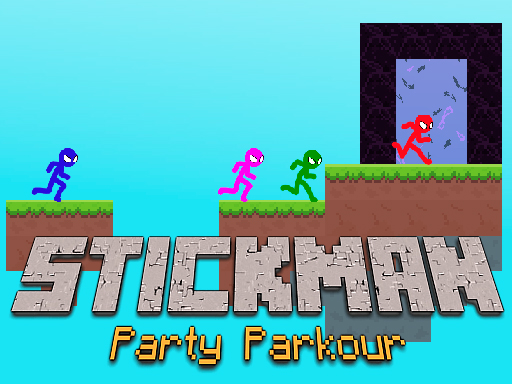
Stickman Team Parkour Adventure is a cooperative arcade game built around paired play. Up to four players split into two teams of two, and each team controls a pair of stickmen through obstacle-filled courses. The goal is straightforward: get both stickmen on your team to the exit door at the end of each level. Because each team is responsible for its own pair, success depends on keeping both characters alive and moving together rather than racing ahead individually.
Obstacles and Level Progression
Courses are filled with moving barriers and gaps that require careful timing to pass. Touching an obstacle or falling off a cliff forces the team to restart that level, so every jump and movement carries weight. The level design introduces new challenges as you progress, keeping the gameplay fresh without relying on complex mechanics. Simple controls for moving and jumping mean the difficulty comes from coordination and timing, not from memorizing button combinations.
Communication and Timing
Since each team controls two stickmen simultaneously, communication becomes the core skill. Teammates need to coordinate their movements, call out incoming barriers, and time their jumps together. When one stickman falls or hits an obstacle, the whole team restarts the level, which encourages patience and strategy over rushing. The game supports up to four players, making it suitable for family game nights or casual sessions with friends.
Visual Style and Accessibility
The stickman visuals are simple and uncluttered, which keeps the focus on the obstacle courses themselves. This minimal presentation makes the game easy to pick up for players of different ages and experience levels. The lighthearted tone and straightforward objectives create a low-pressure environment where trial and error is part of the fun. Progressive difficulty ensures that teams face increasingly tricky courses as they improve.
Compatibility
• OS: Windows 10+, macOS 11+, iOS 14+, Android 10+
• Browsers: Chrome 100+, Safari 15+, Edge 100+, Firefox 100+
• Not compatible with Internet Explorer
Tested on real devices ✅ works as expected












Editorial Notes