What Players Actually Do
Every tile starts face down. A click reveals a number, and the goal is to find its identical partner somewhere else on the grid. Two matching tiles stay face up; two mismatched tiles flip back after a short pause. The entire session runs until every pair has been cleared. There is no timer, no score penalty, and no rulebook to memorize, so the only demands on the player are attention and recall.
Why Multiplication Products Appear on the Tiles
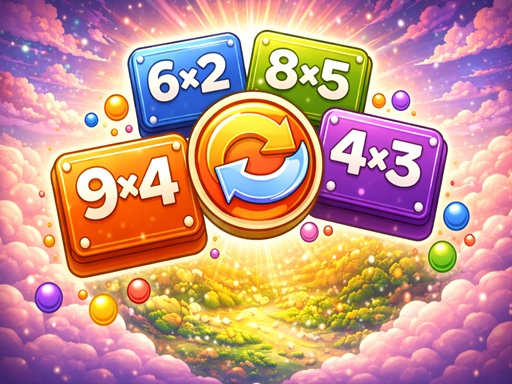
The numbers hidden under the tiles are products of multiplication problems, and all values stay under 100. That ceiling keeps the content inside the range early elementary students typically encounter. When a child flips a tile showing 24, they are not just storing a position in memory; they are also reinforcing the fact family behind that number. Memory and arithmetic practice happen in the same action rather than in separate exercises.
Difficulty and Pacing
The game is built around a relaxed pace. Because nothing forces a decision within a time limit, children can study each revealed number for as long as they need before flipping the next tile. The description also notes that adjustable grid sizes or difficulty levels may be available, which would let adults scale the challenge to a child's current comfort level. Even without that adjustment, the untimed structure means the game never punishes a slow but careful player.
Who Gets the Most From It
This suits children who are just beginning to explore math concepts and who benefit from repetition without pressure. The bright, simple visual style and free browser-based access lower the barrier to entry: no download, no account, no cost. Parents looking for a low-stakes way to add multiplication recall practice to a routine will find the format familiar, since it borrows the tile-matching structure many kids already know from other memory games.
Compatibility
Play on Any Device | Chrome / Safari / Edge Recommended











Editorial Notes