Swapping Shards on a Cosmic Grid
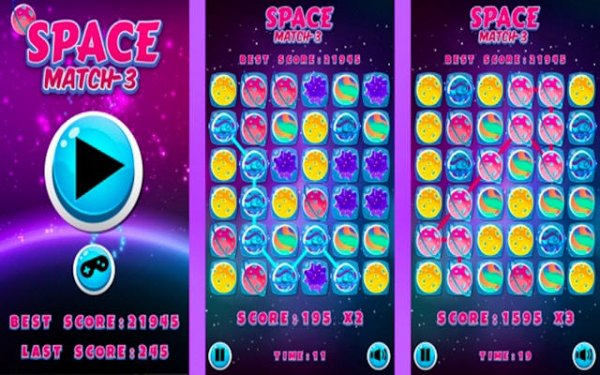
Stellar Shard Swap places players in front of a grid packed with brightly colored, space-themed tiles. The only action required is selecting two neighboring shards and exchanging their positions. When three or more identical shards form a horizontal or vertical line, they disappear, and fresh tiles drop in from above to fill the gaps. That single exchange-and-clear loop is the entire foundation of the game, and every level is built on top of it.
Level Goals That Change the Board
Each stage hands the player a concrete target rather than a vague score chase. Some levels ask for a set number of shards in one specific color to be cleared. Others introduce crystal-like obstacles that block parts of the grid, and the objective becomes breaking through them. Because the win condition shifts from level to level, the same swap mechanic demands different priorities: sometimes color collection matters most, sometimes board access does. That variety is what keeps individual puzzles from feeling like repeats of one another.
Cascades and Planned Matches
Clearing a match is not always the end of the turn. As new tiles fall, they can line up with existing shards and set off chain reactions, often wiping out large sections of the board at once. These cascades award bonus points, which makes them worth chasing deliberately. A common approach is to build matches near the bottom of the grid, since falling tiles from lower rows have more opportunities to connect on the way down. Players who think a move or two ahead tend to finish level goals with fewer swaps than those who react to whatever is visible.
Power-Ups and When to Spend Them
Special items appear during play and can remove an entire row, a column, or a cluster of shards. They are not automatic wins; they are choices. Holding a power-up until the board is crowded with obstacles, or until a level objective specifically needs one shard color, usually produces a better result than firing it off early. Treating them as a reserve for difficult moments is the more efficient habit.
No Clock, No Pressure
Stellar Shard Swap does not run a countdown timer. Players can study the grid for as long as they like before making a swap. That design decision lowers the pressure considerably and makes the game approachable for younger players or anyone who wants a calm mental exercise rather than a reflex test. Sessions can last a few minutes or stretch longer, depending on how many levels the player wants to work through.
Visual Presentation and Mood
The space theme is carried by saturated shard colors set against a dark cosmic background. The interface stays clean and uncluttered, which keeps attention on the puzzle grid itself. The overall look supports the unhurried pace of the gameplay, so each successful match reads as a small, satisfying moment rather than a burst of spectacle.
✅ Compatibility & Testing
• Desktop (Windows 11, macOS Ventura)
• Mobile (iPhone 14, Samsung Galaxy S23)
• Tablet (iPad Pro, Android tablet)
✅Supported browsers: Chrome, Safari, Edge, Firefox (latest versions)
❌ Not supported: Internet Explorer, older browser versions











Editorial Notes