Throwing Mechanics and Match Flow
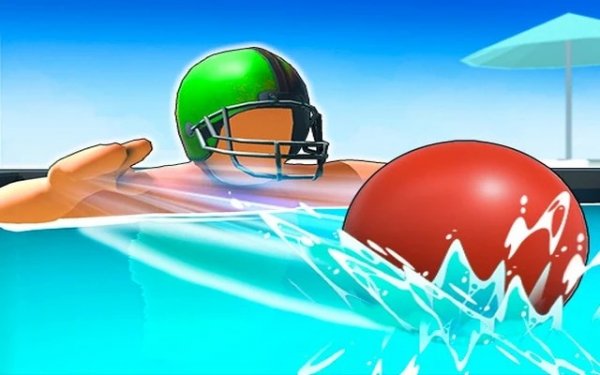
Splash Court Toss Battle is built around a single repeated decision: when to throw and where to aim. Two characters move freely across a colorful pool surface, and each player uses simple directional inputs plus one action button to launch a throw. Landing a throw on the opponent pushes them off balance or adds to your score. Because matches often last only a few minutes, every throw carries weight; a missed attempt gives the other player room to reposition. The control scheme stays deliberately small, so the challenge comes from reading movement rather than memorizing commands. [IMG_1]
Beyond Basic Scoring
The game changes its objective across several modes. One mode follows a wrestling-style format where knocking the opponent over earns points. Another shifts toward a soccer-like challenge, asking players to aim throws into a goal area. A career mode may also be present, offering structured progression against increasingly tough opponents. These formats keep the core throwing mechanic intact while altering what counts as success, which adds replay value without adding control complexity. [IMG_2]
Visual Style and On-Screen Feedback
Bright, cartoon-like graphics place the action against a sunny pool backdrop. Characters use exaggerated features that stay easy to tell apart during fast exchanges. Water splashes and cheerful sound effects follow each throw, reinforcing the playful tone. The interface stays clean, with clear indicators for scores and remaining time. That combination supports short, stress-free sessions where the visual feedback tells you what happened without needing to read menus. [IMG_3]
Character Customization and Skill Growth
Players can personalize characters with visual tweaks such as different outfits, color schemes, or accessories. These changes affect appearance only, not gameplay, and the system allows quick swaps between matches. Success still depends on reading the opponent's movement and adjusting aim accordingly. Predicting where the other player will move becomes a key skill in faster modes. Accuracy matters more than power, and varying throwing angles and timing tends to work better than repeating a predictable pattern. Newcomers can enjoy matches from the start, but practice rewards players who learn to counter habits.
Compatibility
This H5 game runs smoothly on:
• Desktop computers (Windows / Mac) • Mobile phones (iPhone / Android)
• Tablets (iPad / Android)
🌐 Best experienced with Chrome, Safari, or Edge




Editorial Notes