Core Platforming Loop
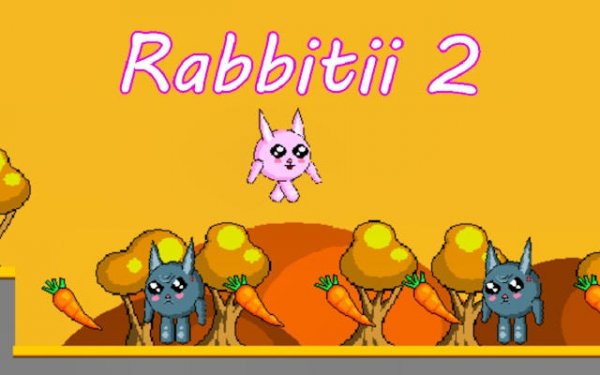
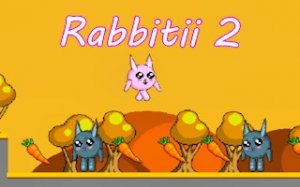
Each level in Rabbitii 2: Carrot Journey asks the same fundamental question: how do you collect every carrot and reach the pink finish flag without touching spikes or crossing paths with rival characters? The rabbit moves left and right and jumps, with a double jump that extends reach to high platforms and concealed sections. Carrots are not always placed along the most obvious route, so scanning the level before moving often saves a restart. The finish flag only unlocks the next stage once the level's objective is met, which keeps attention on completion rather than speed.
Movement and Risk Management
The double jump is the mechanic that separates a cautious run from an efficient one. It allows the rabbit to recover from a mistimed jump or to reach a ledge that a single jump cannot clear. Hazards are fixed, not random, so enemy patterns and spike placements can be observed and learned. That predictability is what makes the game approachable for newcomers while still rewarding players who plan a route before committing to it.
Difficulty Progression and Session Design
Levels are arranged in a progressive sequence, with later stages layering more obstacles and tighter jump windows onto the same control scheme. The difficulty curve is described as smooth, meaning early levels teach the timing and spacing that later levels demand. Because each stage is short, the game fits naturally into brief play sessions, and replaying earlier levels is a practical way to sharpen the jump timing needed for harder sections.
Visual Style and Audience
The presentation uses colorful, inviting visuals and a rabbit protagonist, which gives the game a family-friendly tone. That tone does not remove the challenge: precision still matters, and the double jump is a tool for exploration as much as for survival. Players who enjoy classic 2D platforming with a clear collect-and-finish structure are the most likely audience, while those seeking combat systems or narrative depth will find the focus elsewhere.
Compatibility
✅ Works on PC & Mobile | Recommended: Chrome / Safari / Edge







Editorial Notes